
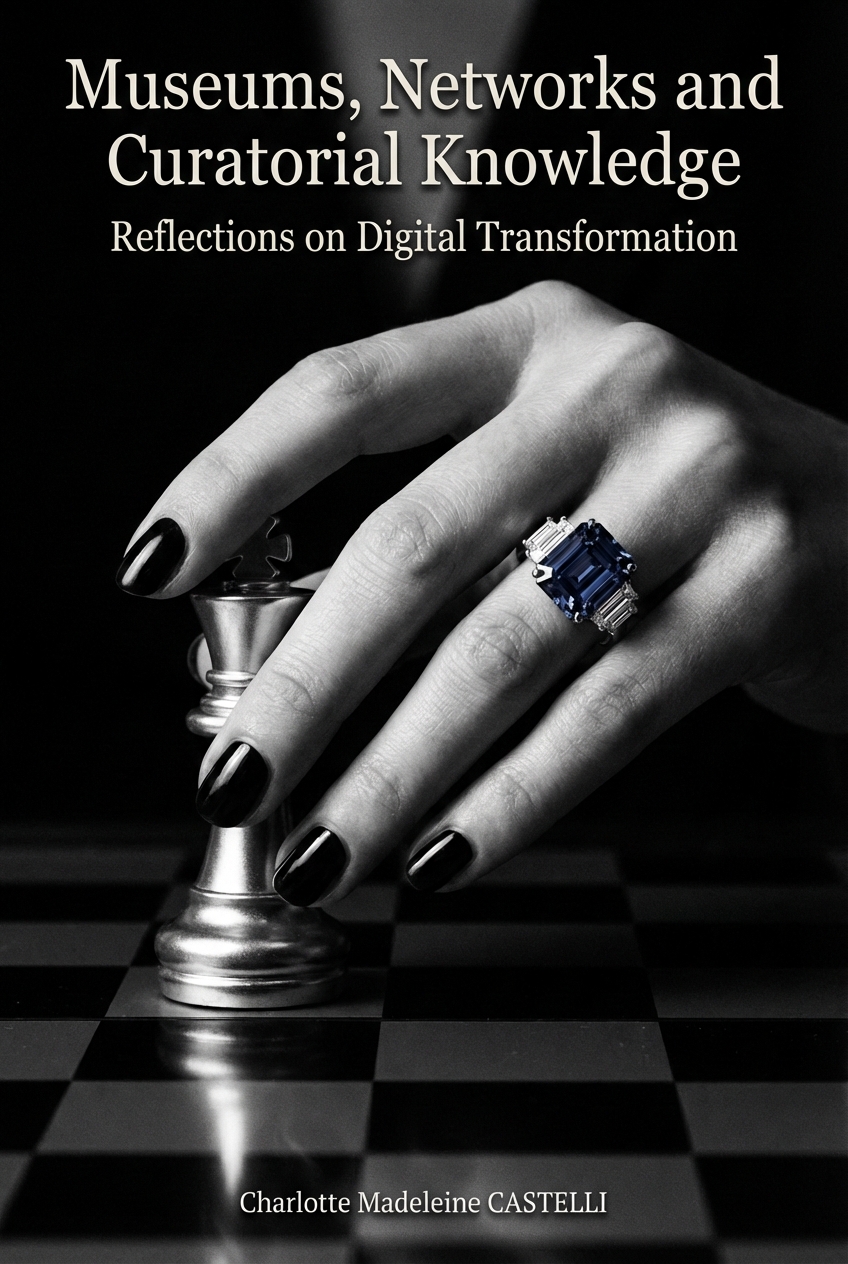
Museums, Networks, and Curatorial Knowledge
Reflections on Digital Transformation
€20.00
This study examines how museums can undergo digital transformation without sacrificing the museum’s core vocation as a space of duration, attention, and contemplative encounter. Building on Giuliano Gaia’s concept of the “immediate museum” as articulated in Il Museo Immediato, it distinguishes immediacy from mere speed, proposing immediacy as a qualitative, relational threshold that intensifies perception rather than compressing experience. Through a curatorial lens, the text frames digital mediation as a form of temporal architecture: a deliberate orchestration of rhythms—access, delay, immersion, and reflection—capable of multiplying interpretive layers while preserving the integrity of material presence.
The theoretical framework draws on open-work participation and interpretive co-construction (Umberto Eco), ethical-humanistic responsibility in cultural institutions (Giulio Carlo Argan), critiques of simulation and loss of the real (Jean Baudrillard), and the processual temporality of contemporary culture (Boris Groys). Against this backdrop, it analyzes digital tools—AI personalization, AR/VR reconstructions, blockchain-based provenance, immersive interfaces, and 3D reproduction—not as neutral enhancements, but as epistemic instruments requiring curatorial governance to prevent distraction, bias, or spectacle.
Case studies—Rijksmuseum, British Museum, and Smithsonian Institution—are placed in dialogue with practice-based reflections anchored in Future Maastricht Museum and Gallery, including the ENCI quarry area as a paradigm for layered heritage immersion. The study concludes by outlining curatorial strategies for “relational immediacy,” arguing that the museum’s digital future depends on ethical mediation that deepens—rather than accelerates—how visitors inhabit time, meaning, and memory.